
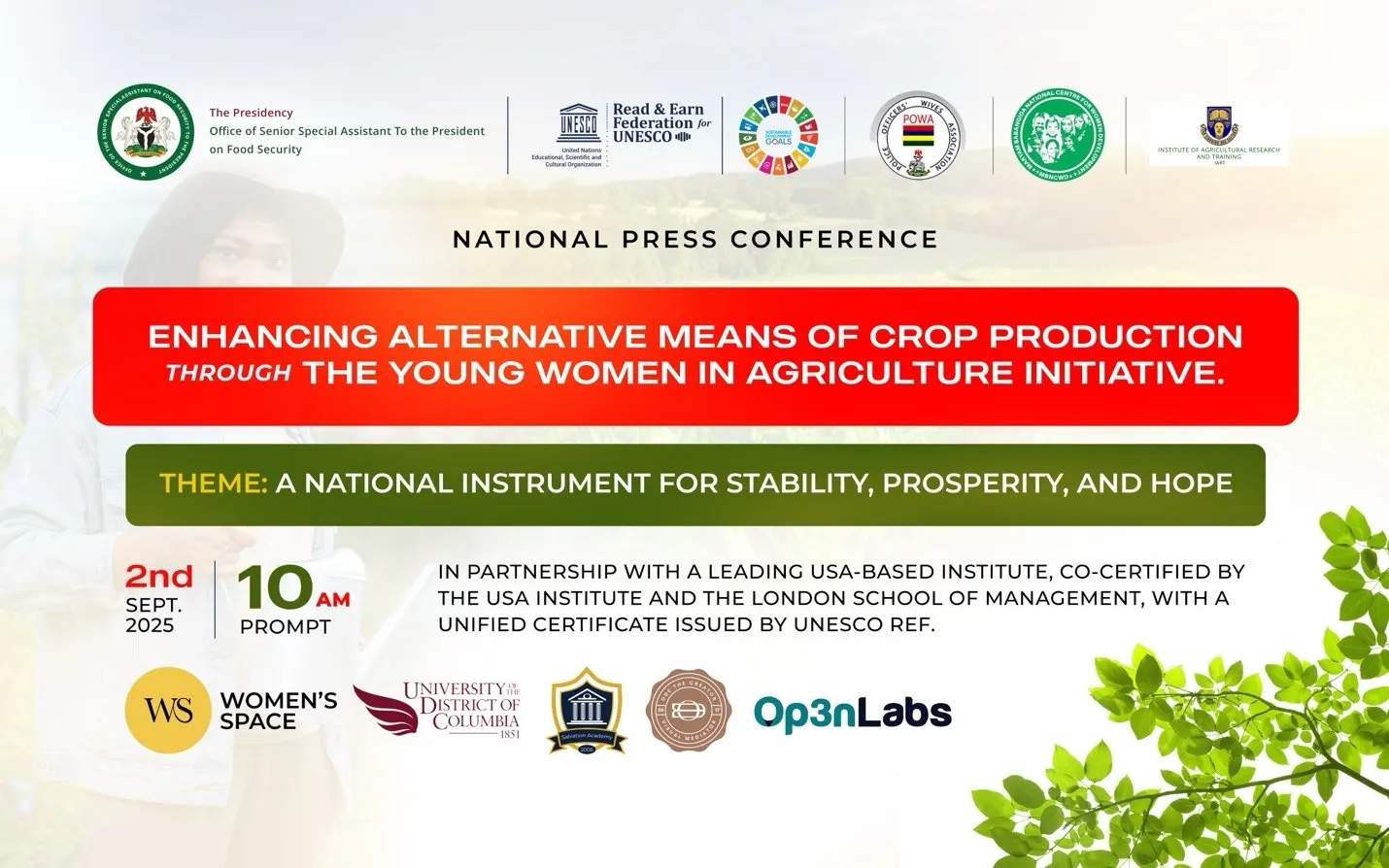
National press conference on the Young Women in Agriculture initiative, Abuja, 2 September 2025

Federal Government Declares Intention to Broker Financial Support for 4.5 Million Nigerians under Young Women in Agriculture

Federal Government Declares Intention to Broker Financial Support for 4.5 Million Nigerians under Young Women in Agriculture

The DispatchUNESCO REF Media Centre · EISSN 3156-55574 min read

UNESCO REF Media Centre | Institutional Archives

At a joint national press conference, the Office of the Senior Special Assistant to the President on Food Security announced its intention to broker financial support for three million participants in the first phase and 1.5 million in the second.

ABUJA, Nigeria, 2 September 2025. The Federal Government of Nigeria, through the Office of the Senior Special Assistant to the President on Food Security, Barr. Yejide Ogundipe, today declared its intention to broker financial support for the participation of at least three million Nigerians in the first phase and 1.5 million in the second phase of the Young Women in Agriculture (YWA) National Empowerment Programme of the Read and Earn Federation for UNESCO (UNESCO REF). The announcement was made at a joint national press conference in Abuja convened by UNESCO REF, the Police Officers’ Wives Association (POWA), the Federal Road Safety Corps and the Maryam Babangida National Centre for Women Development.

Global alignmentAlignement mondialThe global commitments this story advances. Open to see how.
  • SDG2

    SDG 2, Zero Hunger

    ProvisionTarget 2.3: raise the productivity and incomes of small-scale food producers

    How the programme respondsFinances the participation of millions in productive agriculture

  • SDG13

    SDG 13, Climate Action

    ProvisionTarget 13.1: strengthen resilience and adaptive capacity to climate hazards

    How the programme respondsPromotes climate-smart hydroponic and kenaf production

  • SDG5

    SDG 5, Gender Equality

    ProvisionTarget 5.a: equal rights to economic resources

    How the programme respondsPrioritises young women among beneficiaries

  • SDG1

    SDG 1, No Poverty

    ProvisionTarget 1.2: reduce poverty

    How the programme respondsBuilds livelihoods through new agricultural value chains

  • SDG17

    SDG 17, Partnerships for the Goals

    ProvisionTarget 17.17: effective public and civil society partnerships

    How the programme respondsJoins the Presidency, national agencies and UNESCO REF

The Presidency’s declaration

La déclaration de la Présidence

Delivering the message of the Presidency, Barr. Ogundipe described food security under the Renewed Hope Agenda of President Bola Ahmed Tinubu as “a covenant with the Nigerian people”. With more than 25 million Nigerians facing food insecurity, she presented the intervention as both urgent and historic. “Through my office, the Presidency will broker the financial support required to ensure that millions of Nigerians benefit from this National Empowerment Programme,” she declared. “This is not just an agricultural intervention; it is a national security and empowerment strategy.”

Beneficiaries are to include young women, young people across all six geopolitical zones and civil servants approaching retirement.

Strategic leadership and global alignment

Leadership stratégique et alignement mondial

The President of UNESCO REF and National Coordinator of YWA, Prince Abdulsalami Ladigbolu-Oranmiyan, situated the programme within the national emergency on food security declared on 13 July 2023 and within the 2030 Agenda, Agenda 2063 and the Renewed Hope Agenda. He set out its delivery framework: a first phase of online training in hydroponics, offered in English, Hausa, Yoruba, Igbo and Pidgin; a second phase of in-person kenaf workshops at six regional hubs; internationally recognised certification together with a unified UNESCO REF certificate; and structured offtake arrangements designed to give certified producers a dependable income.

A coalition of institutions

Une coalition d’institutions

The Director-General of the Maryam Babangida National Centre for Women Development described the press conference as “a strategic inflection point in our collective effort to secure Nigeria’s food future and expand women’s economic opportunity”, and confirmed the Centre’s mandate as National Secretariat: to coordinate actors across all tiers of government, to monitor progress against milestones and to evaluate impact through 2030.

Dr Elizabeth Egbetokun, National President of POWA, reported on grassroots mobilisation: the designation of POWA chairpersons nationwide as state contact points; the launch in July 2025 of the Soil to Security Campaign; and the establishment of Soil to Security Cells in all 774 local government areas and within the civil service. The first cohort of trainees, largely POWA members, was completing training in preparation to apply its skills in communities.

The coalition joins the Office of the Senior Special Assistant on Food Security in brokering financial support; UNESCO REF in strategic leadership and programme oversight; the Centre as Secretariat for monitoring and evaluation; POWA in grassroots mobilisation; and the Road Safety Officers’ Wives Association in logistical and safety support.

An intergenerational undertaking

Une entreprise intergénérationnelle

Within a broader mobilisation of 12 million, the programme aims to reach 4.5 million direct beneficiaries across its two phases, to establish new agricultural enterprises and value chains in rural communities, and to position Nigeria as a continental leader in climate-smart agriculture. Its trainees are intended to become the mentors of those who follow. The declaration is entered in the Institutional Archives of the UNESCO REF Media Centre.

The significance of the declaration

La portée de la déclaration

The declaration by the Office of the Senior Special Assistant to the President on Food Security represents an important institutional milestone in the life of the Young Women in Agriculture initiative. It signals that the Federal Government regards the initiative not as a project of one institution but as a national empowerment programme worthy of facilitation by the Presidency, and it establishes a framework through which financial support may be mobilised for the participation of millions of Nigerians.

For UNESCO REF, the declaration confirms the strategic choice made at the launch of the initiative in 2023: to design a national response to food insecurity that combines training, technology, grassroots mobilisation and market access, and to anchor it in partnership with government. The financing framework now announced complements the work of the National Secretariat at the Maryam Babangida National Centre for Women Development, the scientific support of national research institutions and the mobilisation led by POWA across the Federation.

The declaration also reflects the growing recognition, in Nigeria and internationally, that food security is a dimension of national security. By placing the empowerment of young women and youth at the centre of the national food system, the initiative addresses at once the supply of food, the creation of livelihoods and the strengthening of social cohesion, objectives that lie at the heart of the 2030 Agenda and of the Renewed Hope Agenda.

■

Notes to editorsNotes aux rédactions

About Young Women in Agriculture. Young Women in Agriculture (YWA) is a national empowerment initiative of UNESCO REF under the Strategic Intervention Programme ALPHA (SIP-ALPHA). It seeks to mobilise 12 million young Nigerian women, two million from each geopolitical zone, into agriculture as producers, entrepreneurs and leaders. Read more on the YWA page.

About UNESCO REF. The Read and Earn Federation for UNESCO (UNESCO REF) is a multidimensional and multisectoral development institution established in 2009 within the provisions of UNESCO, as authorised by the 13th Session of the UNESCO General Conference, Paris, 1964, and constituted through the National Commission for UNESCO, Nigeria. It works in education, culture, youth development and the advancement of the Sustainable Development Goals.

Media enquiries. UNESCO REF Media Centre, info@unescoref.org
SourcesSources
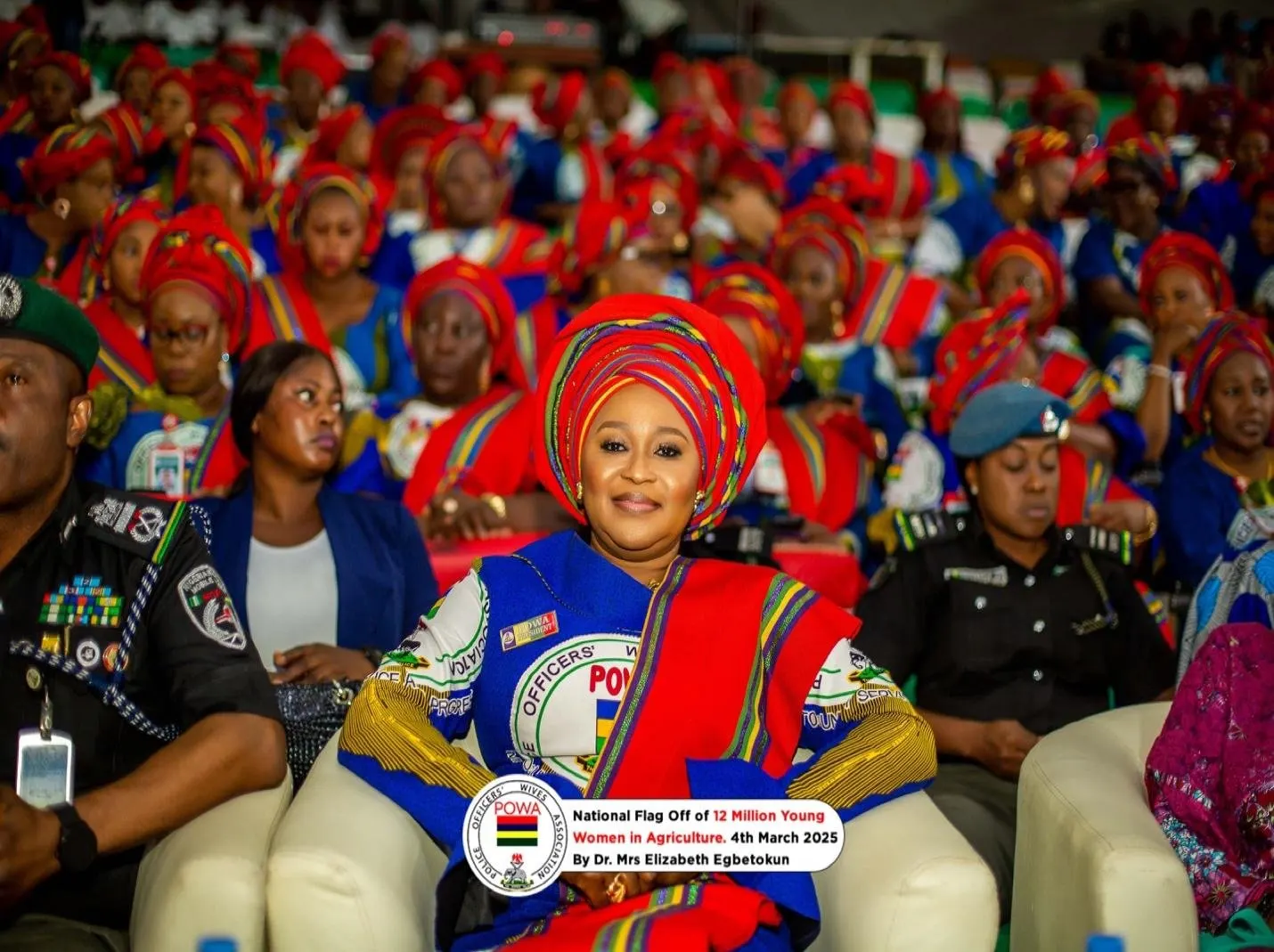
Dr Elizabeth Egbetokun with YWA Champions at the National Flag-Off, Abuja, 4 March 2025

Nigeria Flags Off the UNESCO REF 12 Million Mobilisation Campaign for Young Women in Agriculture on International Women’s Day 2025

Nigeria Flags Off the UNESCO REF 12 Million Mobilisation Campaign for Young Women in Agriculture on International Women’s Day 2025

The DispatchUNESCO REF Media Centre · EISSN 3156-55574 min read

UNESCO REF Media Centre | Institutional Archives

At the Maryam Babangida National Centre for Women Development, global, national and community leadership converged to flag off a campaign to equip 12 million Nigerian women and youth in hydroponics and kenaf enterprise.

ABUJA, Nigeria, 4 March 2025. The National Flag-Off of the UNESCO REF 12 Million Mobilisation Campaign for Young Women in Agriculture (YWA) took place today at the Maryam Babangida National Centre for Women Development, Abuja, in commemoration of International Women’s Day 2025. The campaign, recognised as a National Empowerment Programme under the UNESCO REF Strategic Intervention Programme ALPHA (SIP-ALPHA), seeks to mobilise and equip 12 million Nigerian women and youth with skills in hydroponics and agro-kenaf enterprise development.

Global alignmentAlignement mondialThe global commitments this story advances. Open to see how.
  • SDG2

    SDG 2, Zero Hunger

    ProvisionTarget 2.3: raise the productivity and incomes of small-scale food producers, in particular women

    How the campaign respondsEquips women and youth for productive, climate-smart agriculture

  • SDG5

    SDG 5, Gender Equality

    ProvisionTarget 5.a: equal rights to economic resources

    How the campaign respondsPlaces agricultural enterprise at the centre of women’s economic empowerment

  • SDG1

    SDG 1, No Poverty

    ProvisionTarget 1.2: reduce the proportion of people living in poverty

    How the campaign respondsBuilds livelihoods through value-chain agribusiness

  • SDG8

    SDG 8, Decent Work and Economic Growth

    ProvisionTarget 8.6: reduce youth not in employment, education or training

    How the campaign respondsTrains and certifies young people for enterprise

  • SDG16

    SDG 16, Peace, Justice and Strong Institutions

    ProvisionTarget 16.1: reduce violence

    How the campaign respondsAdvances non-kinetic approaches to national security

  • AU

    African Union Agenda 2063

    ProvisionAspiration 6: development driven by the potential of African women and youth

    How the campaign respondsOffers a continental model of women-led food security

A global charge

Un appel mondial

In her keynote address, the United Nations Deputy Secretary-General, Amina J. Mohammed, framed the campaign as a contribution to the 2030 Agenda: “Every woman empowered is a community strengthened, every girl educated is a nation advanced. Nigeria’s 12 million Mobilisation Campaign is not just a national initiative; it is a global contribution to the 2030 Agenda.” She presented women’s empowerment not as charity but as strategy, the most effective pathway to peace and prosperity.

National commitments

Engagements nationaux

The Honourable Minister of Women Affairs, Hajia Imaan Sulaiman-Ibrahim, described YWA as a pillar of the Renewed Hope Agenda of President Bola Ahmed Tinubu: “When women are empowered, families are stronger, communities are safer, and nations are more prosperous. This campaign is a practical demonstration of our government’s resolve to ensure that women are not left behind but are leading the charge in building a secure and prosperous Nigeria.”

The Inspector-General of Police, Dr Kayode Adeolu Egbetokun, described the campaign as a non-kinetic approach to national security: “Food security is national security. When our women and youth are empowered to produce food, to create wealth, and to sustain their families, we are not only reducing hunger but also reducing crime, insecurity, and instability. A well-fed nation is a safer nation.”

Speaking for the Presidency, Barr. Yejide Ogundipe, Senior Special Assistant to the President on Food Security, declared: “Through my office, the Presidency will broker the financial support required to ensure that millions of Nigerians benefit from this National Empowerment Programme. Food security under the Renewed Hope Agenda is not merely policy, it is a covenant with the Nigerian people.”

Hon. Dr Asabe Vilita Bashir, Director-General of the Maryam Babangida National Centre for Women Development, confirmed the Centre as National Secretariat of YWA: “This is a performance mandate, not a ceremonial assignment. The Centre will ensure that every action taken under this programme translates into measurable impact for women, families, and communities across Nigeria.”

Science, accountability and the UNESCO family

Science, redevabilité et famille de l’UNESCO

The Institute of Agricultural Research and Training, Ibadan, represented through its leadership under Professor Veronica Obatolu, assured stakeholders of its role as the technical backbone of the programme: developing a practical training curriculum, upholding agronomic standards with a focus on climate-smart practice, and embedding research-driven innovation. “This initiative bridges research and practice,” the Institute affirmed.

Dr Lateef Olagunju, Secretary-General of the Nigerian National Commission for UNESCO, aligned the campaign with the values of UNESCO: “The Young Women in Agriculture initiative is a model of how UNESCO’s values, education, empowerment, and equity, can be translated into practical programmes that change lives. We call on donor agencies, development partners, and the private sector to join hands with us in scaling this vision.”

Leadership of the campaign

La conduite de la campagne

Dr Elizabeth Egbetokun, National President of POWA and National Advocate for YWA, traced the initiative from its launch in June 2023 and set out its scale: 12 million women, two million in each geopolitical zone, over 2024 to 2027 and extendable to 2030, with pioneer beneficiaries beginning training on 10 March 2025. She urged Nigerians at home and abroad to embrace the cause, and expressed gratitude to the First Lady, Senator Oluremi Tinubu, and to His Imperial Majesty, the Ooni of Ife, Oba Adeyeye Enitan Ogunwusi, Ojaja II.

The President of UNESCO REF and National Coordinator of YWA, Prince Abdulsalami Ladigbolu-Oranmiyan, set the campaign within Nigeria’s economic history: dependence on oil, the recession of 2016, low agricultural productivity, post-harvest losses and rising food imports. He identified four objectives: to diversify the economy; to strengthen the capacity of women and youth as a non-kinetic contribution to national security; to facilitate agribusiness investment, including to help beneficiaries meet their obligations under the national student loan scheme; and to break the cycle of poverty through value-chain agribusiness. “This flag-off represents more than a formal start,” he said. “It symbolises the strength, resilience, and determination of our women. It is a commitment to build a sustainable and inclusive agricultural sector.”

Prof. Hafsat Ganduje added that “the mobilisation of 12 million young women into agriculture is not just about food production, it is about dignity, opportunity, and security for families across Nigeria.”

Voices of beneficiaries

La parole des bénéficiaires

Beneficiaries spoke of the change already under way. “As a PhD holder, my life’s work has been dedicated to research and knowledge creation,” said Dr Egan Okon-Effiong. “Through the Young Women in Agriculture programme, I discovered that knowledge must also feed people.” Mrs Chidi Nzota, a Deputy Director in the Federal Ministry of Science and Technology, said the training and mentorship had given her practical skills in hydroponics and agribusiness that “have opened new doors”.

The flag-off bound together government, international institutions, academia, civil society, security agencies, traditional leadership and citizens in one shared mission. It is entered in the Institutional Archives of the UNESCO REF Media Centre; the full record of the day is published in the YWA Campaign Report.

■

Notes to editorsNotes aux rédactions

About Young Women in Agriculture. Young Women in Agriculture (YWA) is a national empowerment initiative of UNESCO REF under the Strategic Intervention Programme ALPHA (SIP-ALPHA). It seeks to mobilise 12 million young Nigerian women, two million from each geopolitical zone, into agriculture as producers, entrepreneurs and leaders. Read more on the YWA page.

About the Maryam Babangida National Centre for Women Development. The Centre serves as the National Secretariat of the Young Women in Agriculture initiative.

About UNESCO REF. The Read and Earn Federation for UNESCO (UNESCO REF) is a multidimensional and multisectoral development institution established in 2009 within the provisions of UNESCO, as authorised by the 13th Session of the UNESCO General Conference, Paris, 1964, and constituted through the National Commission for UNESCO, Nigeria. It works in education, culture, youth development and the advancement of the Sustainable Development Goals.

Media enquiries. UNESCO REF Media Centre, info@unescoref.org
SourcesSources
UNESCO Headquarters, Paris

UNESCO REF Partners with the Association of Community Pharmacists of Nigeria to Advance the Global Goals on Health

UNESCO REF Partners with the Association of Community Pharmacists of Nigeria to Advance the Global Goals on Health

The DispatchUNESCO REF Media Centre · EISSN 3156-55574 min read

UNESCO REF Media Centre | Institutional Archives

Under SIP-ALPHA’s health category, UNESCO REF and the Association of Community Pharmacists of Nigeria join forces to strengthen community health and advance Sustainable Development Goal 3.

ABUJA, Nigeria, 12 February 2024. The Read and Earn Federation for UNESCO (UNESCO REF) has entered into a strategic partnership with the Association of Community Pharmacists of Nigeria (ACPN) to strengthen community health systems and accelerate progress towards the health-related Sustainable Development Goals. The partnership was concluded during a working visit by the President of UNESCO REF, Prince Abdulsalami Ladigbolu-Oranmiyan, to the National Chairman of ACPN, Prince Adewale Oladigbolu, in Abuja.

Global alignmentAlignement mondialThe global commitments this story advances. Open to see how.
  • SDG3

    SDG 3, Good Health and Well-being

    ProvisionTarget 3.1: reduce maternal mortality; Target 3.8: access to quality essential health services and medicines

    How the partnership respondsMobilises community pharmacists for health education and access to medicines

  • SDG3

    SDG 3, Good Health and Well-being

    ProvisionTarget 3.d: strengthen capacity for early warning and management of health risks

    How the partnership respondsBuilds community resilience to epidemics and health emergencies

  • SDG17

    SDG 17, Partnerships for the Goals

    ProvisionTarget 17.17: effective public and civil society partnerships

    How the partnership respondsJoins a national professional association with a development institution

Health within the Strategic Intervention Programme ALPHA

La santé au sein du Programme d’intervention stratégique ALPHA

The partnership is implemented under Category 1, Health, of the UNESCO REF Strategic Intervention Programme ALPHA (SIP-ALPHA), through its National Health Emergency Response and Resilience Programme (NHERRP). It focuses on community sensitisation, knowledge exchange and advocacy to reduce maternal mortality, to improve access to quality health care and to promote sustainable health practices in communities across Nigeria.

NHERRP is designed to strengthen national capacity in four areas: to respond to emergencies such as epidemics, pandemics and climate-related health crises; to build resilience in health systems so that essential services continue during shocks; to engage communities through pharmacists, health workers and civil society in awareness and behavioural change; and to advance SDG 3, Good Health and Well-being, by aligning community action with global health priorities.

The place of the community pharmacist

La place du pharmacien d’officine

Community pharmacists occupy a distinctive place in the Nigerian health system. For millions of Nigerians, the community pharmacy is the first and most accessible point of contact with professional health advice, often before any clinic or hospital. That position makes community pharmacists uniquely placed to carry health education into communities, to support the prevention and early detection of disease, and to improve access to essential medicines.

By joining the Association of Community Pharmacists of Nigeria to its health programme, UNESCO REF gains a professional partner with presence across the Federation and the trust of the communities it serves.

Areas of cooperation

Domaines de coopération

The partnership provides for cooperation in three principal areas. The first is community sensitisation, in which pharmacists and UNESCO REF jointly carry health information to communities, with particular attention to maternal health, the prevention of epidemic disease and the responsible use of medicines. The second is knowledge exchange, through which the professional expertise of community pharmacists informs the design of the Federation’s health interventions. The third is advocacy, in which the partners work together to place community health on the agenda of policymakers and development partners.

The voice of the partners

La parole des partenaires

Speaking during a working visit to the National Chairman of ACPN in Abuja, the President of UNESCO REF set out the purpose of the partnership: “The purpose of this engagement is to seek a strategic partnership on health priority schemes, through knowledge exchange, advocacy, and the sensitisation of communities on the need to be part of the global effort towards the realisation of Goal 3. This partnership is designed to advance the health-related global goals, with a spotlight on combating maternal mortality and epidemics, and ensuring the accessibility of essential health care services.”

The National Chairman of ACPN, Prince Adewale Oladigbolu, welcomed the collaboration: “Community pharmacists are the first point of contact for millions of Nigerians. Through this partnership with UNESCO REF, we will expand our role in health education, disease prevention, and access to essential medicines. Together, we can bridge the gap between global health goals and local realities.”

The partnership carries a distinctive personal dimension. The two leaders are cousins, and their collaboration joins an institutional alliance to a shared family heritage of public service and a common commitment to building healthier and more resilient communities.

A whole-of-society approach

Une approche associant toute la société

The partnership reflects a whole-of-society approach to public health, in which government, professional associations, civil society and communities each have a part to play. UNESCO REF brings to that effort its experience in mobilisation, education and partnership; ACPN brings professional knowledge and a network of practitioners embedded in the daily life of communities.

The international context

Le contexte international

The initiative is consistent with the global effort to strengthen pharmaceutical education and the pharmaceutical workforce, in which the International Pharmaceutical Federation (FIP) and UNESCO have established UNITWIN Centres of Excellence. By linking community action in Nigeria with international frameworks, the partnership reflects the interdependence of health, education and sustainable development that lies at the heart of the mandate of the UNESCO family.

It also responds to the commitment of the 2030 Agenda that no one be left behind. Maternal health, in particular, remains among the most pressing development priorities in Nigeria and across sub-Saharan Africa, and progress depends on informed communities as much as on clinical services.

Institutional significance

Portée institutionnelle

The partnership marks a significant step in aligning community health action in Nigeria with the 2030 Agenda for Sustainable Development. It extends the work of UNESCO REF beyond education, culture and agriculture into public health, consistent with the multidimensional and multisectoral character of the Federation, and it demonstrates the value of professional associations as partners in national development.

This record is entered in the Institutional Archives of the UNESCO REF Media Centre.

■

Notes to editorsNotes aux rédactions

About ACPN. The Association of Community Pharmacists of Nigeria represents community pharmacists across the Federation.

About UNESCO REF. The Read and Earn Federation for UNESCO (UNESCO REF) is a multidimensional and multisectoral development institution established in 2009 within the provisions of UNESCO, as authorised by the 13th Session of the UNESCO General Conference, Paris, 1964, and constituted through the National Commission for UNESCO, Nigeria. It works in education, culture, youth development and the advancement of the Sustainable Development Goals.

Media enquiries. UNESCO REF Media Centre, info@unescoref.org
SourcesSources
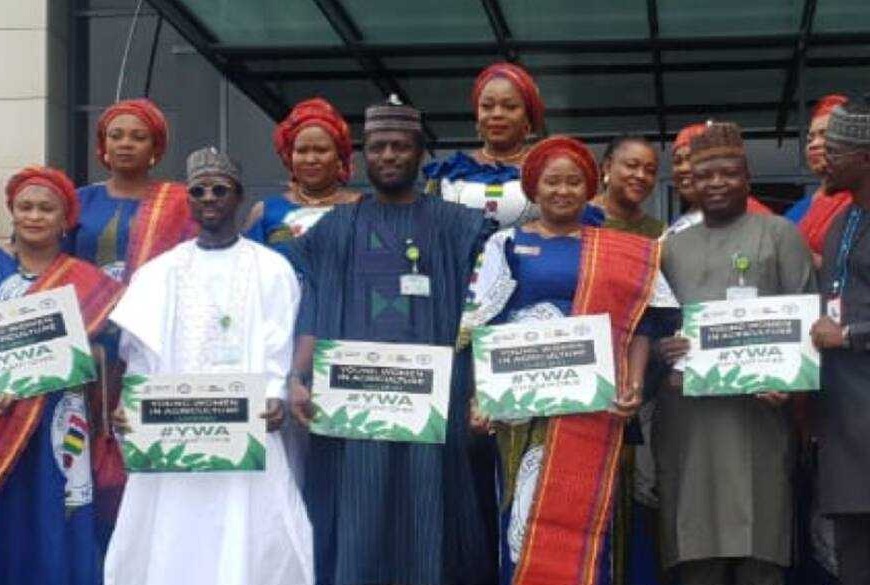
Young Women in Agriculture Champions at the National Assembly, Abuja

House of Representatives, UNESCO REF and POWA Forge Institutional Synergy for Young Women in Agriculture

House of Representatives, UNESCO REF and POWA Forge Institutional Synergy for Young Women in Agriculture

The DispatchUNESCO REF Media Centre · EISSN 3156-55574 min read

UNESCO REF Media Centre | Institutional Archives

At the National Assembly, the House Committee on Diaspora, UNESCO REF and the Police Officers’ Wives Association joined their institutional strengths in a partnership for the Goals, directed towards responsible and sustainable food production in Nigeria.

ABUJA, Nigeria, 29 September 2023. The House of Representatives, through its Committee on Diaspora, the Read and Earn Federation for UNESCO (UNESCO REF) and the Police Officers’ Wives Association (POWA) today formalised an institutional synergy in support of the Young Women in Agriculture (YWA) initiative at a joint press briefing at the House of Representatives wing of the National Assembly, Abuja. Conceived in the spirit of Sustainable Development Goal 17, Partnerships for the Goals, the synergy is directed towards the attainment of Sustainable Development Goal 12, Responsible Consumption and Production, in Nigeria, through a more productive, less wasteful and more resilient national food system.

Global alignmentAlignement mondialThe global commitments this story advances. Open to see how.
  • SDG17

    SDG 17, Partnerships for the Goals

    ProvisionTarget 17.17: encourage and promote effective public, public-private and civil society partnerships

    How the synergy respondsJoins the legislature, a development institution and a national association in one framework of action

  • SDG12

    SDG 12, Responsible Consumption and Production

    ProvisionTarget 12.3: reduce food losses along production and supply chains, including post-harvest losses

    How the synergy respondsDirects the partnership towards production, storage and the reduction of waste in the national food system

  • SDG2

    SDG 2, Zero Hunger

    ProvisionTarget 2.3: raise the productivity and incomes of small-scale food producers, in particular women

    How the synergy respondsMobilises young women as productive members of the agricultural workforce

  • SDG5

    SDG 5, Gender Equality

    ProvisionTarget 5.a: equal rights to economic resources

    How the synergy respondsPlaces women at the centre of the revival of Nigerian agriculture

  • AU

    African Union Agenda 2063

    ProvisionAspiration 6: development driven by the potential of African women and youth, including the diaspora

    How the synergy respondsEngages Nigerians at home and in the diaspora in national food security

A partnership for the Goals

Un partenariat pour les objectifs

Sustainable Development Goal 17 recognises that no single institution can achieve the 2030 Agenda alone. It calls for effective partnerships between public institutions, civil society and the private sector, in which each brings its distinctive mandate and capacity to a common purpose. The synergy concluded at the National Assembly gives practical expression to that principle in the field of food security.

Each partner brings a complementary institutional strength. The House of Representatives, through its Committee on Diaspora, brings the authority of the legislature, its oversight of national priorities and its capacity to engage Nigerians abroad. UNESCO REF brings the programme leadership of the Young Women in Agriculture initiative under the Strategic Intervention Programme ALPHA, and its alignment with the Sustainable Development Goals. POWA brings a permanent, structured presence in every State of the Federation, through which women can be reached, organised and supported.

Together, the three institutions resolved to mobilise at least 100,000 young women into productive agriculture as an early contribution to the national mobilisation of the initiative, strengthening the agricultural workforce and the value chains on which the national food supply depends.

Towards responsible and sustainable production

Vers une production responsable et durable

Sustainable Development Goal 12 calls on nations to ensure sustainable patterns of consumption and production. In the food system, one of its central targets, Target 12.3, is the reduction of food losses along production and supply chains, including post-harvest losses. For Nigeria, this is a question of the first importance. A significant share of what Nigerian farmers produce is lost between harvest and market, through inadequate storage, processing and transport.

The President of UNESCO REF has drawn attention to the scale of the challenge, observing at a sensitisation workshop with POWA in August 2023 that Nigeria’s food storage capacity stood at about five per cent, against some twenty-five per cent in South Africa, and that UNESCO REF holds a long-term plan to introduce modern food storage. The synergy concluded at the National Assembly places that concern at the heart of a national partnership: the women mobilised through the initiative are to be equipped not only to produce, but to produce responsibly, to preserve what they grow and to add value to it.

In this sense, the partnership treats food security not simply as a matter of producing more, but of producing better: increasing yields while reducing waste, strengthening storage and processing, and building value chains that are efficient, sustainable and inclusive.

The voice of the legislature

La voix du législateur

Rt Hon Tanko Adamu, Chairman of the House Committee on Diaspora, described the partnership as a move from words to action: “This is going beyond the rhetoric to combat food security.” He explained that the initiative would work through an institutionalised mechanism, using the established structure of POWA to involve young women in agriculture across the country, and that it would contribute to the provision of nutritious food and the creation of jobs and economic opportunities.

The Chairman called on Nigerians in the diaspora to return home and contribute to the revival of the agricultural sector, and affirmed that the Committee’s partnership with POWA and UNESCO REF would help mobilise Nigerians abroad to invest in, and lend technical support to, the agricultural economy of the nation.

The commitments of POWA and UNESCO REF

Les engagements de la POWA et de l’UNESCO REF

Dr Elizabeth Egbetokun, President of POWA and National Advocate for Young Women in Agriculture, announced the commitment of her association: “As President of POWA, I am mobilising 100,000 women to boost the agricultural workforce.” She described the mobilisation as a contribution to strengthening the agricultural value chain and to reducing the social pressures that arise from food scarcity.

The President of UNESCO REF, Prince Abdulsalami Ladigbolu-Oranmiyan, emphasised that national development rests on cooperation between citizens and the institutions of government. He described the synergy as a timely response to the call by President Bola Ahmed Tinubu, made in New York, for Nigerians in the diaspora to come home and invest in the country, and as a means of channelling that invitation towards one of the most pressing national priorities.

Institutional significance

Portée institutionnelle

The synergy at the National Assembly marked the first formal engagement of the national legislature with the Young Women in Agriculture initiative. It established a channel between the initiative and the House of Representatives, extended its reach to Nigerians in the diaspora and reinforced the role of POWA as the principal grassroots partner of the initiative across the 36 States and the Federal Capital Territory.

For UNESCO REF, the engagement illustrates the institutional method by which the Federation pursues the Sustainable Development Goals: by joining public institutions, civil society and citizens in partnerships that are practical, accountable and directed to measurable results. This record is entered in the Institutional Archives of the UNESCO REF Media Centre.

■

Notes to editorsNotes aux rédactions

About Young Women in Agriculture. Young Women in Agriculture (YWA) is a national empowerment initiative of UNESCO REF under the Strategic Intervention Programme ALPHA (SIP-ALPHA). It seeks to mobilise 12 million young Nigerian women, two million from each geopolitical zone, into agriculture as producers, entrepreneurs and leaders. Read more on the YWA page.

About the House Committee on Diaspora. The Committee on Diaspora of the House of Representatives of the Federal Republic of Nigeria oversees matters relating to Nigerians abroad and their engagement in national development.

About POWA. The Police Officers’ Wives Association of Nigeria is a national association with a permanent structure across the Federation.

About UNESCO REF. The Read and Earn Federation for UNESCO (UNESCO REF) is a multidimensional and multisectoral development institution established in 2009 within the provisions of UNESCO, as authorised by the 13th Session of the UNESCO General Conference, Paris, 1964, and constituted through the National Commission for UNESCO, Nigeria. It works in education, culture, youth development and the advancement of the Sustainable Development Goals.

Media enquiries. UNESCO REF Media Centre, info@unescoref.org
SourcesSources
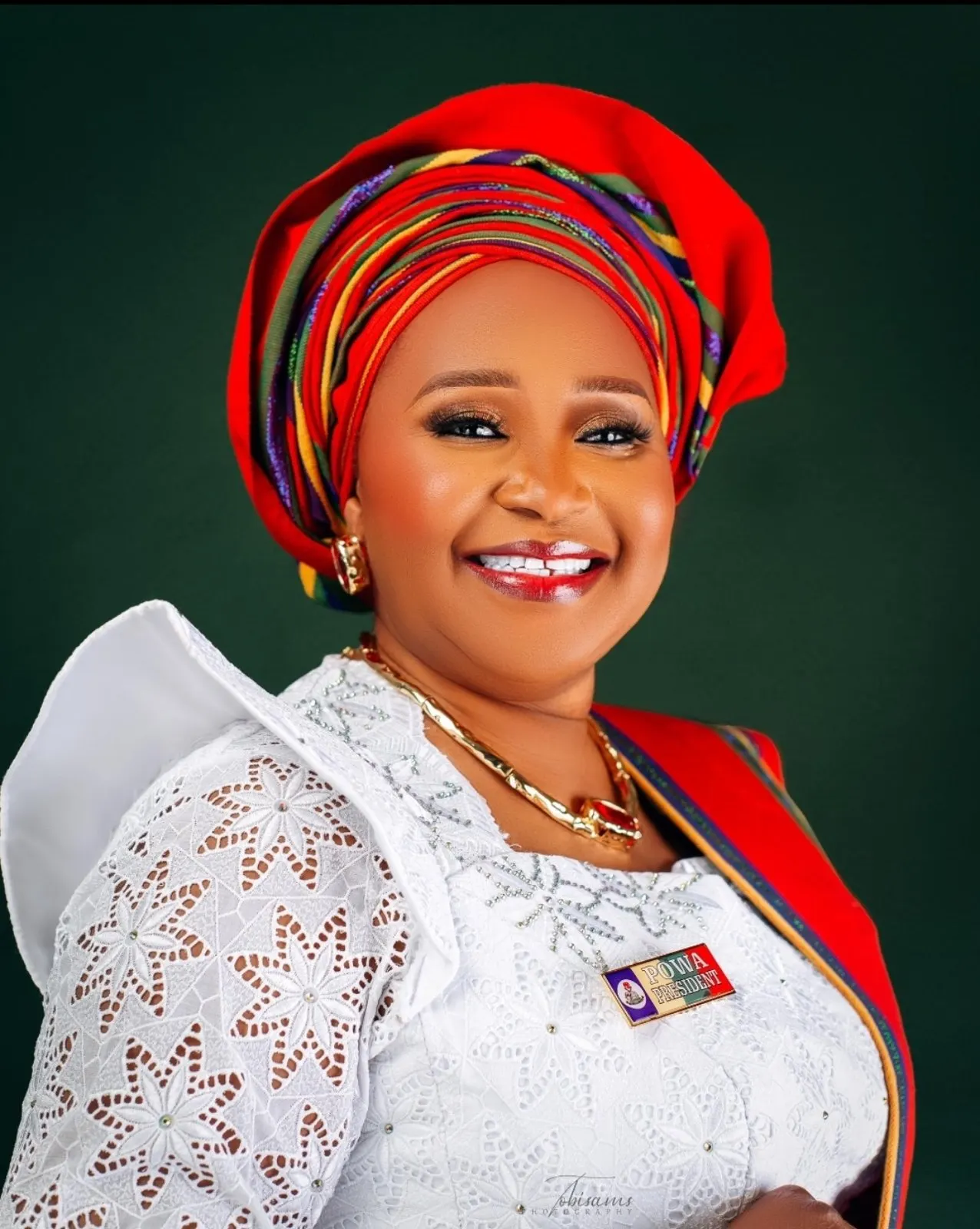
Dr Elizabeth Egbetokun, National Advocate for Young Women in Agriculture

UNESCO REF Appoints Dr Elizabeth Egbetokun as National Advocate for Young Women in Agriculture

UNESCO REF Appoints Dr Elizabeth Egbetokun as National Advocate for Young Women in Agriculture

The DispatchUNESCO REF Media Centre · EISSN 3156-55574 min read

UNESCO REF Media Centre | Institutional Archives

The President of the Police Officers’ Wives Association becomes the national voice of an initiative to bring 12 million young Nigerian women into agriculture.

ABUJA, Nigeria, 19 July 2023. The Read and Earn Federation for UNESCO (UNESCO REF) today announced the appointment of Dr (Mrs) Elizabeth Egbetokun, President of the Police Officers’ Wives Association of Nigeria (POWA), as National Advocate for the Young Women in Agriculture (YWA) initiative. The appointment reflects the commitment of UNESCO REF to women’s leadership in agriculture, to national food security and to the empowerment of a new generation of women farmers and agricultural entrepreneurs.

Global alignmentAlignement mondialThe global commitments this story advances. Open to see how.
  • SDG5

    SDG 5, Gender Equality

    ProvisionTarget 5.5: women’s full participation and equal opportunities for leadership

    How the appointment respondsPlaces a woman leader at the head of national advocacy

  • SDG2

    SDG 2, Zero Hunger

    ProvisionTarget 2.3: raise the productivity and incomes of women food producers

    How the appointment respondsMobilises women into productive agriculture

  • SDG17

    SDG 17, Partnerships for the Goals

    ProvisionTarget 17.17: effective public and civil society partnerships

    How the appointment respondsJoins UNESCO REF to a national association with nationwide reach

An appointment of national purpose

Une nomination d’intérêt national

The appointment of a National Advocate is among the most significant decisions UNESCO REF takes in the life of a national initiative. The National Advocate carries the public voice of the initiative, represents it before government, traditional institutions and civil society, and inspires the participation of those it is designed to serve. In appointing Dr Egbetokun, the Federation entrusted that responsibility to a leader whose standing, experience and national network are commensurate with the scale of the initiative.

As President of the Police Officers’ Wives Association, Dr Egbetokun leads one of the oldest and most extensive women’s associations in the Federation, with a permanent structure in every State. That structure gives the initiative an immediate and dependable means of reaching women in cities, towns and rural communities across the country.

The mandate of the National Advocate

Le mandat de l’Ambassadrice nationale

Under the terms of her appointment, the National Advocate will champion programmes that encourage young women to embrace agriculture as a profession and an enterprise; engage traditional rulers, State Governments and civil society so that agricultural initiatives answer the needs and circumstances of local communities; and support the implementation of the agriculture and youth advancement categories of the Strategic Intervention Programme ALPHA across Nigeria.

The mandate places particular emphasis on mobilisation and inclusion: ensuring that young women in every zone of the Federation know of the initiative, understand its benefits and are supported to take part.

Why advocacy matters

Pourquoi le plaidoyer est essentiel

Advocacy is not an ornament to a national programme; it is a condition of its success. Initiatives that seek to change patterns of participation in a sector as large and as traditional as agriculture must persuade as well as provide. Young women must be convinced that agriculture offers them a future; families must be assured that it is a worthy path; and communities, traditional rulers and governments must be engaged as partners rather than spectators.

The National Advocate carries that work of persuasion. Through public engagement, partnership with traditional institutions and the reach of a national association, she gives the initiative a human face and a trusted voice, and helps to translate a national policy objective into a decision that millions of young women can make for themselves.

A strategic appointment

Une nomination stratégique

The President of UNESCO REF, Prince Abdulsalami Ladigbolu-Oranmiyan, described the appointment as strategic: “Dr Elizabeth Egbetokun brings not only vision and dedication, but a personality that radiates confidence, compassion, and strength. Working with her is an advantage for UNESCO REF and for Nigeria, because she embodies the bridge between leadership and grassroots mobilisation. Through POWA’s permanent structure across the Federation, she has the unique ability to reach women in every corner of the country. This network will contribute meaningfully to mobilising women for agriculture, ensuring that no community is left behind. Her appointment is not just symbolic, it is strategic.”

Acceptance

Acceptation

In accepting the appointment, Dr Egbetokun said: “I am deeply honoured to serve as UNESCO REF’s National Advocate for Young Women in Agriculture. This role is not about me, it is about the millions of young women whose hands till the soil, whose resilience feeds families, and whose dreams deserve to be nurtured. With UNESCO REF’s vision, and with the permanent nationwide structure of POWA as a backbone, we will mobilise women across Nigeria to see agriculture not as survival, but as opportunity, dignity, and prosperity. Together, we will plant seeds of change that will grow into a harvest of hope for generations to come.”

The record of service

Le bilan de service

In the period since her appointment, the National Advocate has led the grassroots mobilisation of the initiative across the Federation. Under her leadership, POWA chairpersons in every State were designated as contact points for the initiative; the Soil to Security Campaign was launched; and Soil to Security Cells were established across the local government areas of the Federation and within the civil service. She addressed the National Flag-Off of the 12 Million Mobilisation Campaign on International Women’s Day 2025.

The appointment reflects a principle that guides UNESCO REF in all its national initiatives: that women’s leadership is central to sustainable development, consistent with SDG 5 and the commitment of the 2030 Agenda to the full and effective participation of women in public life. This record is entered in the Institutional Archives of the UNESCO REF Media Centre.

■

Notes to editorsNotes aux rédactions

About Young Women in Agriculture. Young Women in Agriculture (YWA) is a national empowerment initiative of UNESCO REF under the Strategic Intervention Programme ALPHA (SIP-ALPHA). It seeks to mobilise 12 million young Nigerian women, two million from each geopolitical zone, into agriculture as producers, entrepreneurs and leaders. Read more on the YWA page.

About POWA. The Police Officers’ Wives Association of Nigeria is a national association with a permanent structure across the Federation.

About UNESCO REF. The Read and Earn Federation for UNESCO (UNESCO REF) is a multidimensional and multisectoral development institution established in 2009 within the provisions of UNESCO, as authorised by the 13th Session of the UNESCO General Conference, Paris, 1964, and constituted through the National Commission for UNESCO, Nigeria. It works in education, culture, youth development and the advancement of the Sustainable Development Goals.

Media enquiries. UNESCO REF Media Centre, info@unescoref.org

SourcesSources